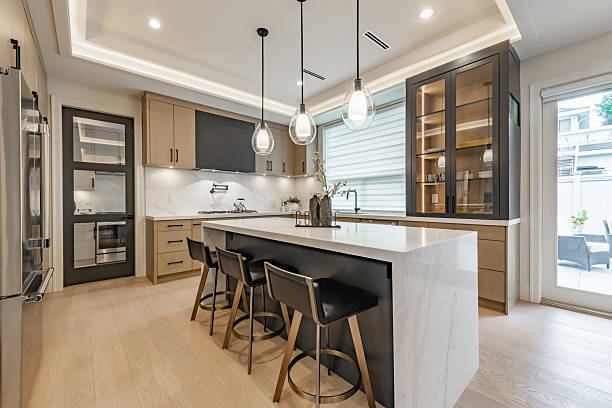
We handles every appliance installation by the code.
No two appliance installations are the same from a code perspective.
Slide-in, freestanding, and built-in ranges require proper anti-tip bracket installation, connection to the correct circuit amperage, and gas line hookup for dual-fuel models. We handle every step.
DetailsCounter-depth, French door, and built-in refrigerators require leveling, door alignment, and water line connection for ice makers and dispensers. We run water lines and handle all connections.
DetailsDishwasher installation involves supply line connection, drain line hookup to the air gap or disposer, electrical connection, and leveling to prevent door clearance issues. We handle the full install.
DetailsOver-the-range microwaves and range hoods require cabinet mounting, ductwork connection or recirculation filter installation, and electrical connection. Improperly mounted units are a safety hazard.
DetailsGas appliance connections require a licensed professional and a pressure test after connection to confirm no leaks. We pull required permits in Zimmerman and perform all required post-connection testing.
DetailsWe disconnect, remove, and haul away your old appliances as part of every installation project. No double-scheduling, no old appliances sitting on your driveway waiting for pickup.
Details
The delivery crew will sometimes offer to set up an appliance in place and call it installed -- but professional installation and truly compliant installation are different things, and the difference matters more than most homeowners realize until something goes wrong.
Electrical requirements for kitchen appliances are more complex than a standard outlet swap. A standard electric range typically requires a dedicated 50-amp, 240-volt circuit. A built-in microwave often requires a dedicated 20-amp circuit. Connecting a high-draw appliance to an undersized circuit does not immediately cause a failure -- it causes repeated tripping, premature breaker wear, and in some cases wire overheating that creates a fire hazard over time. Our installation process includes verifying that the circuit serving each appliance meets the appliance manufacturer's specified requirements before we complete the installation.
Gas appliance connections carry the most serious safety risk of any kitchen installation work. A poorly made gas connection -- whether from using the wrong fitting type, failing to apply thread sealant correctly, or overtightening a flex connector until it develops a micro-crack -- can leak at levels too low to smell immediately but high enough to create a combustion hazard over time. We perform a leak test on every gas line we connect. This is not optional or extra-credit work -- it is the minimum standard for gas appliance installation, and it is the step that distinguishes a professional installation from one that merely looks done.
Manufacturer warranties are another often-overlooked reason to use certified installation. Most major appliance manufacturers include a clause in their warranty documentation that voids coverage for damage resulting from improper installation. A dishwasher with a leaking drain connection that floods the cabinet and subfloor is a warranty claim -- unless the installation records show it was not installed correctly, in which case it becomes an out-of-pocket expense. JMT Kitchen Cabinet provides documentation of completed installations.
Anti-Tip Bracket Note: All freestanding ranges are required by CPSC guidelines to have an anti-tip bracket installed. This small bracket prevents the range from tipping forward if weight is applied to the open oven door. It is the most commonly skipped step in range installation and one of the most important safety items in your kitchen.
The risks of DIY appliance installation go beyond inconvenience.
Appliances connected to undersized circuits create repeated breaker trips, prematurely wear the breaker, and in some cases cause wiring to overheat inside walls. The risk is not immediate -- it builds over months of repeated overcurrent events.
Improperly connected gas flex connectors can develop slow leaks at fittings or along the connector body that are too low-level to trigger a CO detector immediately but create a combustion hazard over time. Pressure testing after connection is the only way to confirm a gas installation is safe.
Most appliance manufacturers require professional installation to maintain warranty coverage. An appliance that fails due to an installation error -- water damage, electrical damage, gas pressure issues -- will be denied warranty service if improper installation is identified as the cause.
Gas appliance installation typically requires a permit and inspection in most jurisdictions. Work performed without a permit can create issues during home sale due diligence and, in some cases, trigger a required removal and reinstall at the homeowner's expense.
Nobody told me before I called JMT Kitchen Cabinet that installing a gas range required a pressure test and a permit. The crew explained the whole process, pulled the permit, made the connection, and tested it properly. Complete peace of mind -- I know my range is installed safely.
We were impressed by the attention to detail -- the previous range had never had one installed and the JMT Kitchen Cabinet crew caught it immediately during the assessment. They installed it as part of the new range job. Small thing, huge safety matter.
I was dreading dealing with the old appliances and JMT Kitchen Cabinet just handled it completely. New refrigerator in, old one gone, water line connected and tested, everything working perfectly. One visit, done right.
JMT Kitchen Cabinet installs appliances right the first time in Zimmerman and throughout Zimmerman, MN -- certified, code-compliant, and backed by real documentation.
Schedule Today